- Argentina
- Australia
- Bangladesh
- Belarus
- Belgium
- Brazil
- Bulgaria
- Canada
- China
- Costa Rica
- Egypt
- France
- Germany
- Hong Kong
- India
- Indonesia
- Ireland
- Israel
- Italy
- Japan
- Kenya
- Kuwait
- Malaysia
- Mexico
- Netherlands
- New Zealand
- Nigeria
- Pakistan
- Philippines
- Poland
- Qatar
- Romania
- Russia
- Saudi Arabia
- Singapore
- South Africa
- Spain
- Sri Lanka
- Sweden
- Switzerland
- Thailand
- Turkey
- UAE
- Ukraine
- United Kingdom
- United States


crowdreviews.com
Strategic Partner
August 23, 2017 - August 25, 2017
API 653
Kuala Lumpur, Malaysia
Map Event Location Share this Event
Event Details
Begins: August 23, 2017
End: August 25, 2017
Event Location: Kuala Lumpur, Malaysia
Website: http://www.opuskin..ining-267
Event Organizer
Event Organizer: Opus Kinetic Pte Ltd
Contact Person:
Phone Number: +65 6294 6415
Website: http://www.opuskinetic.com/
Overview
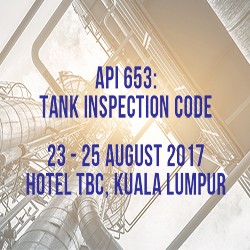
This API exam preparation training course complies with the API (American Petroleum Institute) regulations and is designed to prepare participants for API 653 exam that qualifies successful participants to the “API 653 Tank Inspection Certification. Opus Kinetic certificates will be issued to all attendees completing
minimum of 75% of the total tuition hours of the course. Additionally, quizzes are given at the end of each class day, which consists of 25 questions per day and is reviewed at the beginning of the following day, and a “practice” exam is administered at the end of the course.
Required Codes and Standards
Listed below are the effective editions of the publications required for the September 23, 2009 API 653, Aboveground Storage Tank Inspector Examination.
API Recommended Practice 571, Damage Mechanisms Affecting Fixed Equipment in the Refining Industry (First Edition, December 2003), IHS Product code API CERT 653_571 (includes only the portions specified below)
ATTENTION - Only the following mechanisms to be included:
4.2.7 - Brittle Fracture
4.2.16 - Mechanical Fatigue
4.3.2 - Atmospheric Corrosion
4.3.3 - Corrosion under insulation (CUI)
4.3.8 - Microbiologically Induced Corrosion (MIC)
4.3.9 - Soil Corrosion
4.3.10 - Caustic Corrosion
4.5.1 - Chloride Stress Corrosion Cracking (C1-SCC)
4.5.3 - Caustic Stress Corrosion Cracking (Caustic Embrittlement)
5.1.1.11 - Sulfuric Acid Corrosion
API Recommended Practice 575, Inspection of Atmospheric and Low-Pressure Storage Tanks API Standard 650, Welded Steel Tanks for Oil Storage, IHS Product Code API CERT 650
API Recommended Practice 651 Cathodic Protection of Aboveground Petroleum Storage Tanks API Recommended Practice 652 Lining of Aboveground Petroleum Storage Tank Bottoms.
API Standard 653, Tank Inspection, Repair, Alteration, and Reconstruction
American Society of Mechanical Engineers (ASME)
Key Learning Objectives
• Gain awareness of the Safety Case regime planned for Singapore
• Understand what needs to be included in a Safety Case
• Have insight on a practical approach for identifying and assessing Major
• Accident Hazards
• Understand the significant time and resource requirement to write a
• Safety Case
• Be an intelligent buyer of specialist support for aspects of the Safety Case
• Improve awareness of best practices in stringent regimes that can be adopted to
• meet safety case regulation planned for Singapore.
Contact Details
Email: [email protected]
Website: http://www.opuskinetic.com/details-training-267
Telephone: +65 6294 6415
STAY IN TOUCH


Subscribe to our newsletter.
©2026 CROWDREVIEWS.COM, LLC. All Rights Reserved.
Claim a Profile on CrowdReviews.com
ENHANCE YOUR PROFILE
Claim and update your profile to ensure potential customers get the best impression on what you have to offer.
 Searching for more matching results...
Leave A Review on CrowdReviews.com
