- Argentina
- Australia
- Bangladesh
- Belarus
- Belgium
- Brazil
- Bulgaria
- Canada
- China
- Costa Rica
- Egypt
- France
- Germany
- Hong Kong
- India
- Indonesia
- Ireland
- Israel
- Italy
- Japan
- Kenya
- Kuwait
- Malaysia
- Mexico
- Netherlands
- New Zealand
- Nigeria
- Pakistan
- Philippines
- Poland
- Qatar
- Romania
- Russia
- Saudi Arabia
- Singapore
- South Africa
- Spain
- Sri Lanka
- Sweden
- Switzerland
- Thailand
- Turkey
- UAE
- Ukraine
- United Kingdom
- United States


crowdreviews.com
Strategic Partner
October 16, 2017 - October 17, 2017
Advanced Layer of Protection Analysis (LOPA) Masterclass
Singapore, Singapore
Map Event Location Share this Event
Event Details
Begins: October 16, 2017
End: October 17, 2017
Event Location: Singapore, Singapore
Website: http://www.opuskin..emicals-2
Event Organizer
Event Organizer: Opus Kinetic Pte Ltd
Contact Person:
Phone Number: +65 6294 6415
Website: http://www.opuskinetic.com/
Overview
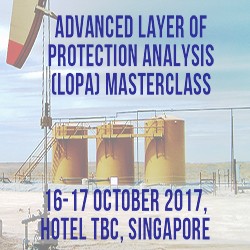
The Buncefield fire was caused by series of explosions at Hertfordshire Oil Storage Terminal back in December 2005, in England. In response to the incident, Major Incident Investigation Board made recommendations to improve safety in the design and operation of fuel storage sites, with the issued final report specified that a Layer of Protection Analysis (LOPA) study be conducted to assess safety integrity level (SIL) to ensure system integrity.
The purpose of LOPA study is to ensure implementation of suitable prevention measures that can control, protect, or mitigate the level of risk because of failure of a process. LOPA has been adopted as good practice method in several European countries and the USA as part of their Major Accident Prevention & Policies and Laws.
Key Learning Objectives
• Participate in LOPA studies and LEARN how to facilitate LOPA studies
• Improve understanding on how to assess different type of risks and the corresponding risk tolerance criteria
• Gain technical insights on how to justify the values of HEP and failure of instruments from BS EN 61511 when calculating Initiating Event (IE) frequency
• Learn the bowtie principle which is useful for analysing high risk scenarios
• Identify pitfalls when conducting LOPA study and or writing LOPA report
• Understand the possibility of mismatched frequency of occurrence between risk involved when assigning failure probability to each component of an Initiating Event (IE)
• Know what the Competent Authorities expect to see
• Gain practical knowledge on LOPA through numerous real-life case studies
STAY IN TOUCH


Subscribe to our newsletter.
©2026 CROWDREVIEWS.COM, LLC. All Rights Reserved.
Claim a Profile on CrowdReviews.com
ENHANCE YOUR PROFILE
Claim and update your profile to ensure potential customers get the best impression on what you have to offer.
 Searching for more matching results...
Leave A Review on CrowdReviews.com
